
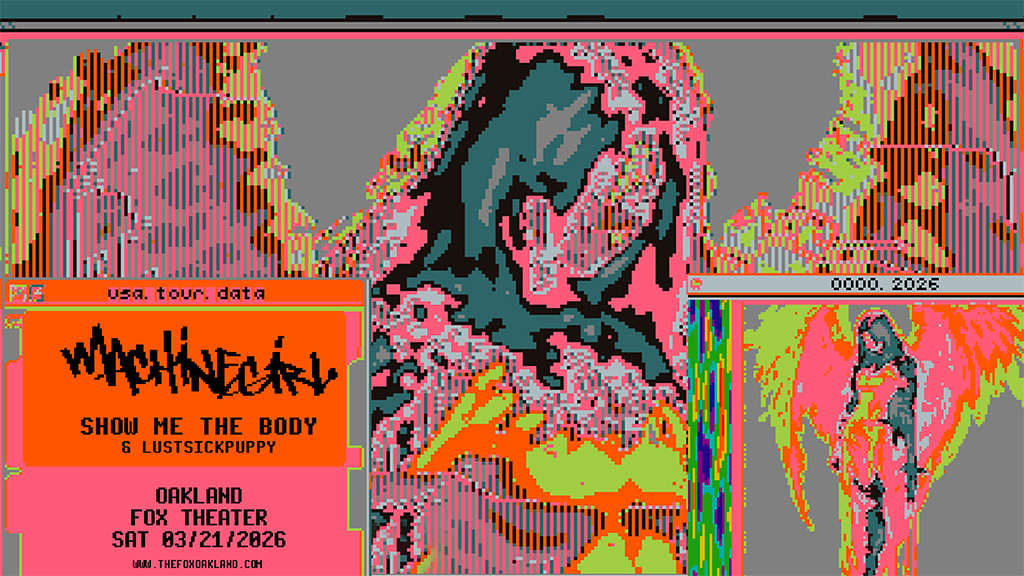
This event is all ages.
For an additional fee, you can opt in to upgrade your experience to include access to the exclusive Telegraph Room before, during and after the show! Please note all Telegraph Room upgrades are subject to availability.
Join us at The Den one hour before doors for food & drinks!
All doors & show times subject to change.
Add this event to your calendar:
Machine Girl
Machine Girl have always operated as an inimitable, inventive, and individual sonic phenomenon. The newly trio’d—Matt Stephenson [vocals, producer], Sean Kelly [drums], and Lucy Caputi [guitar]—fortify a punk exoskeleton with electronic alchemy and cinematic ambition outfitted for an uncompromisingly heavy attack. Rave, metal, punk, and pummeling electronic (and real) drums collide and splinter like shrapnel into kaleidoscopic blasts of vibrant color and visceral sound.
After amassing millions of fans, hundreds of millions of streams, inciting critical acclaim, and captivating at cap crowds in nineteen (19) countries YTD in 2025 so far, the band continue to elevate on their seventh full-length LP, Psycho Warrior.
“I’d been reading analytical psychology and the writings of Joseph Campbell and Jung,” recalls Matt. “There’s a concept of the collective unconscious and these archetypes that we innately have. We adopt different personae in order to get through the day. In essence, you complete yourself by facing your shadow self. To do so, you must accept the less savory aspects of who you are. There’s a lot of validity to these theories. Right now, we’re a very psychologically damaged culture and society. We’re being pushed over the edge with social media and technology. Any chance of resistance against these systems starts in the mind, so this was the genesis of Psycho Warrior.”
Machine Girl carved out an incomparable lane upon arrival in 2012. Stephenson’s 2014 full-length debut LP, Wlfgrl, achieved bona fide cult status shocked to life by “Out by 16, Dead on the Scene,” “Ghost,” and “Mg1,” which reeled in north of 43 million Spotify streams and counting. Their sound proceeded to completely reinvent itself across each LP that followed – Gemini [2015], …Because I’m Young Arrogant and Hate Everything You Stand For [2017], The Ugly Art [2018], U-Void Synthesizer [2020], and 2022’s two-part Original Soundtrack for the video game Neon White. Most recently, 2024’s MG Ultra incited the most enthusiastic critical applause of the band’s career so far. Pitchfork professed, “Their music together plays like the soundtrack to the final boss level of some finger-blistering bullet hell,” and Dazed mused, “it’s hard to imagine a better soundtrack for the revolution than Machine Girl.”
The latter LP also set the stage for Psycho Warrior, functioning as a prelude.
“MG Ultra is the setup,” reveals Matt. “It explores mind control and brings attention to the overall concepts. It’s Act 1. Sonically, it’s more rave-y, but the songs seem hopeless conceptually. Psycho Warrior was made after, and it follows as Acts 2 and 3 of the same arc. Lyrically, it’s more empowering and anthemic. We worked out a lot of the framework with bass guitar and more punk and metal elements.”
Machine Girl recorded this body of work at Civil Defense Recording Studio between Jan – June 2025 in New York, allowing their vision time to naturally take shape.
Now, the single “Come On Baby, Scrape My Data” layers a guttural bassline atop a woozy old school computer loop, conjuring a frenetic bounce from the depths of cyberspace. Matt’s upbeat punky cadence warbles and wheezes on the verses until culminating on a glitchy chant, Wanna know me? Wanna own me? Wanna clone me? F**k you, you can blow me.
“It was written after experiencing something creepy and fucked up either with A.I. or the surveillance state,” he reveals. “My phone knows me way too well—which is a feeling we’ve all gotten very used to within the last ten years. The song teases big tech companies, taunting them to come and try to take our data and identities. It’s a pretty decisive way to open up the record in terms of attitude.”
Elsewhere, brain-rattling beat-craft sets the tempo for “Rabbit Season.” Neon keys chime and echo off in the distance, and a snappy hook takes hold, “I love the feeling.”
“With Machine Girl’s lyrics, I’ll take some dystopian or dark subject matter and flip it into something more lighthearted,” he notes. “I took the concept of conspiracy rabbit holes and used it to make a bouncy dance track. ‘Rabbit Season’ is obviously a reference to Looney Tunes and Bugs Bunny. It discusses the cartoonish world of conspiracies and false, subjective realities people are trapping themselves inside of.”
Then, there’s “Dread Architect” [feat. Drumcorps]. A relentless drum-n-bass barrage crashes into manic screams underlined by groans of fuzzed-out feedback and laser-precise synths.
“To me, ‘Dread Architect’ is almost the antagonist of the whole double-LP,” he states. “It’s the worst of our war-hungry billionaire class leaders who are seething to create a horrible future. We’re witnessing the destruction of the environment worldwide. Mark Zuckerberg and all of these billionaires have already built bunkers for the apocalypse. They’re trying to get out of here and go to Mars. It’s grim and fucked up. Drumcorps is the de facto metalcore breakcore producer extraordinaire. He provided some super gnarly guitar tracks for us to chop up and use too.”
Back in October 2024, the band had welcomed Lucy as a live member. Formally etching out her place in the fold, she handles lead vocals on “Ignore The Vore.” Matt adds, “It’s the first track where my vocals take a backseat, and Lucy is front-and-center. It was an exciting experiment, and it’s a new form of Machine Girl.”
Nearing the six-minute mark, the epic “Psychowar” revolves around the chug of distorted guitars, piston-like percussion, and paranoid pleas a la, “Pass me the Kool-Aid.”
“The goal was always for it to be prog rock-level, epic, and freaky,” he grins. “It’s linked to the central theme. The lines, ‘Fight your Psychowar,’ refer to confronting the parts of yourself you don’t want to confront, overcoming them, and becoming mentally stronger. The first half is darker. On the second, you’re picking yourself up, working on your shit, fighting your ‘Psychowar,’ and becoming a Psycho Warrior.”
In the end, Machine Girl tap into the sound of self-actualization. It’s gritty, dirty, unpredictable, beautiful, and utterly brilliant.
“We really want the music to be life-affirming,” he leaves off. “Catharsis is important in the world of Machine Girl. This is probably the most cathartic album we’ve made.”
Show Me the Body
Show Me The Body is a New York City based ecClesiastical hardcore trio consisting of Julian Cashwan Pratt (founder; banjo and vocals), Harlan Steed (founder; bass), and Jackie McDermott (current drummer). The band has organized non-traditional, intentional DIY spaces for NYC youth since 2015, and since expanded that work to a global capacity through their urgent, ceremonial live shows, subterranean punk and hip-hop mixed tours, and their CORPUS NYC platform. Trouble the Water is the culmination of nearly a decade of barrelling against New York City’s structural ambivalence and indifference; an invocation to a like-minded global community to consider the alchemy of family-building, and of turning water to blood. Trouble the Water both references and pays homage to the physical city, and the New York Sound: not one particular genre, but the people and subcultures that encapsulate it’s true foundation, style, and spirit; while expanding upon and reckoning with the hyperlocal territory of 2019’s Dog Whistle. With Pratt’s most encantatory, interrogative poetry to date, and Steed expanding the glitchy, caustic arena of his electronic experimentation, the band is feeling more like themselves than ever. The founding duo, who have worked together since 2009, used Trouble The Water to methodically inhabit one another’s forms; Pratt experimented recklessly with production and synths, while Steed challenged his own focus to include melodies and riffs.
Although the title invokes the ancient alchemy Moses wielded to free and unite Israelite peoples, Trouble The Water refuses nostalgia, or mimicry. Instead, it considers the sublime power of the unifying physical practices that can be enacted daily, to invoke immeasurable spiritual and collective reactions. Buoyed by moments of stinging stillness and compulsive, almost optimistic, malfunctioning rhythms, the work is literally a conjuration to dance, and move. If we are really living through the end of the world, maybe every movement we make, no matter how slight, is actually boundless and radical. How do we find freedom through rejecting time altogether, and existing only in communion, in space, and in the constellations we form as we choose our “blood” families? Or, as Pratt demands on Demeanor, “What’s better than when we come together? Fighting, dancing, fucking together.” Trouble the Water is at once a homily for those left behind or displaced, and a searing investigation of what survival looks like from within the borders of an aggressively policed city and state, that postures those unignorable calls for rage and migration to a world at war.
Bandmate and long-time music inspiration Jackie McDermott (Sediment Club, Urochromes), joined Show Me the Body in 2020 as drummer, and is featured on the project. Trouble The Water was recorded entirely at the band’s CORPUS Studios in Long Island City, with veteran metal producer Arthur Rizk, and co-engineered by studio co-founder Aidan Bradley. Dog Whistle (2019) was produced by Chris Coady, Show Me The Body and Gabriel Millman. The heavy, honest project was in direct conversation with the oppressive, claustrophobic psychology of the city, and their most critically-acclaimed work to date, described by NME as “a dedication to the community, friends and family at the heart of Show Me The Body” coupled with “the jarring noise and harsh sonics that made [SMTB] one of punk’s most idiosyncratic voices.” Dog Whistle followed Show Me The Body’s now historic, genre-defying debut album Body War (2016).
Since 2015, Show Me the Body have expanded their international music community into an independent label, recording studio, and community organizing platform. The band recently completed their Half-A-USA tour with support from Soul Glo and WiFiGawd, which included their inaugural In Broad Daylight festivals in New York and Los Angeles. Through the intentional cultivation of their local and global chosen families, and a decade-long dedication to sustaining the New York Sound, Show Me the Body has solidified a legacy of confronting and permanently shifting the rigid limitations of the hardcore genre.
LustSickPuppy
LustSickPuppy is perhaps best described as a rapper/producer wielding maniacal electronics, but that doesn’t quite get the full point across. LustSickPuppy takes their love of rap but adds a punk energy, often shouting their lyrics instead of coolly delivering them. Blending that with high octane jungle and other club style beats LustSickPuppy often ends up injecting even higher doses of adrenaline than their forebears. With their new album Carousel From Hell, LustSickPuppy is poised to make their rawest work yet.
Naturally defying categorization, Brooklyn native Tommy Hayes fully embodies the perseverance and limitlessness of a Black artist unafraid of their own power and more than capable of seeing it through. Since 2019, Hayes has only succeeded at transforming inner turmoil into an incomparable and uncompromising sound. Beginning in Bushwick DIY with their first single “Goatmeal,” LustSickPuppy has always been a scholar of digital production, working first with collaborators as with their Cosmic Brownie and As Hard As You Can EP’s before gradually transitioning to working alone. Since the release of As Hard As You Can, LustSickPuppy has toured Europe three times, played Spain’s Primavera Sound Festival, performed at Boiler Room, and opened for artists Dorian Electra and Machine Girl. With Carousel From Hell, LustSickPuppy has fully shifted to self-production.
“I’ve grown up an outsider and a weirdo and just wanted to feel accepted, even though I never really was,” Hayes reveals. “I’ve always felt this tense feeling in my chest that needed to come out and I had no real way of escaping it. I spent years of my life isolated in my head, not knowing who I was or how to feel and was constantly searching for chaos to make sense of the chaos I felt inside me. When I started producing it felt like for the first time I actually tangibly felt and heard all that was going on inside me.”
With knowledge of their stated goals of “genrefucking, representing Black weirdos, de-centering white spaces, destruction of male dominated spaces, representation of femme producers, murder of the patriarchy, and the creation of space for POC queer people,” the distorted shouts atop the atonal frenzy and fist-pumping bass of LustSickPuppy’s work is perfectly contextualized. The songs are born of the mentality of a punk rocker who loves the energy of the club and the expression of movement, and LustSickPuppy facilitates that at each show. Without such context, listeners may be too slow to grasp the importance of the aesthetics reminiscent of Foxy Brown, Lil Kim, and even Wendy O. Williams, likely failing to truly understand just how forward-thinking Hayes’ artistic choices and statements truly are.
“It is my intention to reconnect people with their emotions that have been numbed off of them so that we can return to the depths of feeling.”
Considering the aphorism, “art is supposed to comfort the disturbed and disturb the comfortable,” LustSickPuppy is a natural response to our current societal conditions, and a gift that the world would be smart to recognize as such.